
Epoxy Potting Compound for Automotive Electronics
Automotive electronic systems operate in harsh environments where heat, vibration, moisture, and chemical exposure are unavoidable. To ensure long-term reliability and safety, epoxy potting compounds are widely used to encapsulate and protect sensitive electronic components in automotive applications.
Why Epoxy Potting Is Used in Automotive Applications
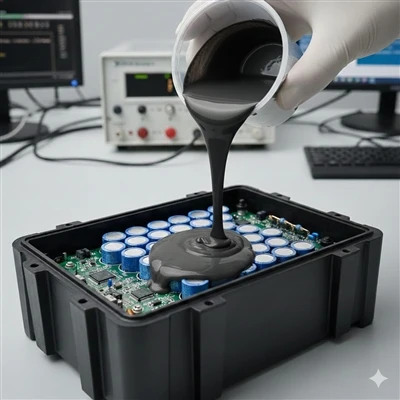
Epoxy potting is a permanent encapsulation process in which a liquid epoxy resin system is poured or injected into an electronic assembly and then cured to form a rigid, protective structure. In automotive electronics, epoxy potting compounds are selected because they provide:
- Excellent mechanical strength to withstand vibration and shock.
- Strong electrical insulation for high-voltage and high-current systems.
- High thermal resistance for continuous operation under elevated temperatures.
- Resistance to moisture, oils, fuels, and automotive chemicals.
These characteristics make epoxy potting compounds a preferred solution for safety-critical and long-life automotive electronic modules.
Key Requirements for Automotive Epoxy Potting Compounds
Not all epoxy potting materials are suitable for automotive use. Automotive-grade epoxy potting compounds are typically required to meet the following criteria:
-
Flame Retardancy
Automotive electronics often require compliance with flame retardancy standards such as UL 94V-0 to reduce fire risk in the
event of electrical failure.
-
Thermal Stability
Potting materials must maintain mechanical integrity and electrical insulation properties over a wide operating temperature range,
including exposure to high under-hood temperatures.
-
Electrical Insulation Performance
High dielectric strength and volume resistivity are essential to protect electronic circuits from short circuits, leakage currents,
and electrical breakdown.
-
Long-Term Reliability
Automotive epoxy potting compounds must deliver consistent performance over long service lifetimes, even under thermal cycling
and continuous vibration.
Typical Automotive Applications of Epoxy Potting
Epoxy potting compounds are commonly used in a wide range of automotive electronic systems, including:
Engine control units (ECUs)
Battery management systems (BMS)
Power inverters and converters
Sensors and control modules
Automotive power supplies and ignition modules
In these applications, epoxy potting not only protects electronic components from environmental damage but also enhances mechanical stability and electrical safety.
Recommended Epoxy Potting Solution
For automotive electronics requiring flame retardancy, high thermal resistance, and permanent encapsulation, 🔗a flame retardant epoxy potting compound such as E536/H536 is commonly used. This type of epoxy system is designed to provide reliable electrical insulation and mechanical protection for automotive ECUs, power modules, and other safety-critical electronic assemblies.
Developed and produced in ISO/IATF-certified facilities for automotive electronics, epoxy potting compounds like E536/H536 are formulated to meet the quality, consistency, and reliability requirements of modern automotive manufacturing.
Conclusion
Epoxy potting compounds play a critical role in protecting automotive electronic systems from thermal, mechanical, and environmental stresses. By selecting an automotive-grade epoxy potting compound with flame retardancy, thermal stability, and strong electrical insulation performance, manufacturers can significantly improve the reliability and service life of their electronic products.
Understanding the application requirements and choosing the appropriate epoxy potting solution is an essential step in the design and production of automotive electronics.


