
-
Phone
+886-2-26824939
-
Address
2F. No.216-2, Zhongzheng Rd., Shulin Dist., New Taipei City 238, Taiwan
-
E-mail
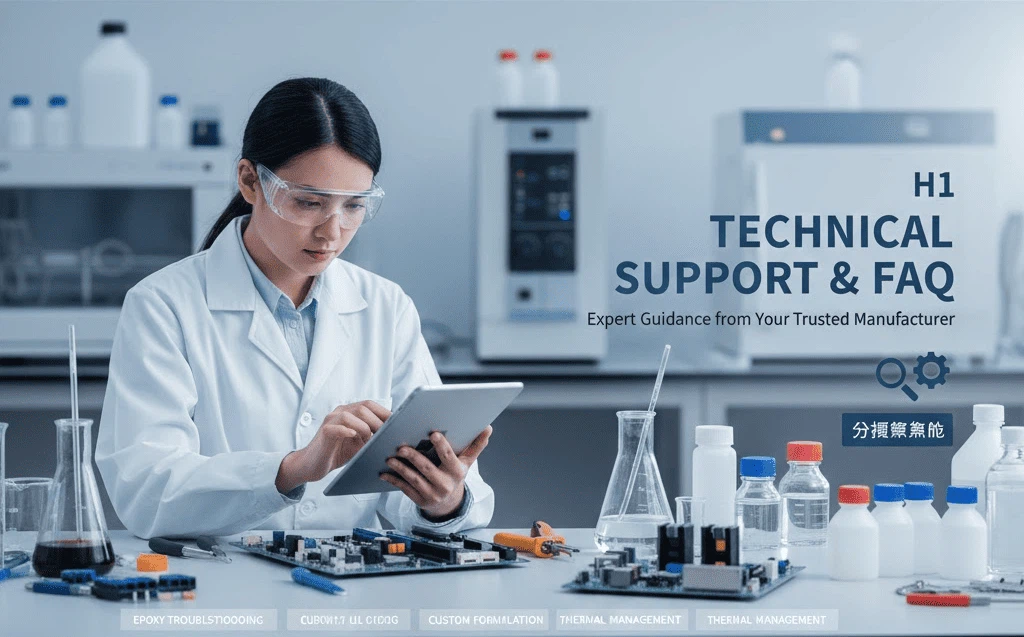
Technical Support: Advanced Resin Troubleshooting and Expert FAQ
Guidance from Your Trusted Epoxy, Silicone, PU & Art Resin Manufacturer
Welcome to the FONG YONG Technical Knowledge Hub. As a leading advanced manufacturer and global supplier, our R&D team is dedicated to solving your most complex chemical challenges. This guide provides expert answers for Industrial Potting, Thermal Management, and Creative Resin Art.
Quick Navigation (Jump to Section):
🔗Section A: Industrial Potting (Epoxy, Silicone, PU)
🔗Section B: Thermal Interface Materials (TIMs)
🔗Section C: Quality, Certification & IATF 16949
🔗Section D: Art & Craft Epoxy Resins (River Tables, DIY)
🔗Section E: Customization & Technical Inquiry
Section A: Industrial Potting & Application Optimization
Q1: Why is my potting resin curing too slowly or remaining tacky?
Answer: Incomplete curing is typically caused by three factors: Incorrect Mix Ratio, Low Ambient Temperature, or Insufficient Mixing.
Mix Ratio: Always use a high-precision scale to follow the weight/weight ratio on the TDS.
Temperature: If ambient temperatures are below 25°C, curing will slow significantly.
Mixing: Ensure you scrape the sides and bottom of the container to prevent unreacted "soft spots."
Keywords: Incomplete cure, tackiness, mix ratio error, resin mixing best practices.
Q2: How to choose the right potting compound for thermal shock resistance?
Answer: For components exposed to rapid temperature changes, Silicone Potting Compounds are ideal due to their low modulus and high flexibility (-50°C to 200°C). They effectively absorb mechanical stress and prevent solder joint fatigue compared to rigid epoxies.
Keywords: Thermal shock, vibration dampening, extreme temperature range, soft gel potting.
Q3: Why choose Polyurethane (PU) over Epoxy for marine electronics?
Answer: Polyurethane Potting Compounds offer superior hydrolytic stability and lower moisture permeability. They act as a superior moisture barrier for underwater sensors and marine electronics at a more cost-effective price point than silicone.
Keywords: Hydrolytic stability, moisture barrier, marine-grade encapsulation, cost-effective potting.
Section B: Thermal Interface Materials (TIMs) & Management
Q4: How to improve heat dissipation in EV batteries or High-Power Computing (HPC)?
Answer: Success depends on selecting a Thermal Interface Material (TIM) with the right Thermal Conductivity (W/m·K) and a low Bond Line Thickness (BLT). Our advanced TIMs are engineered to eliminate air gaps and reduce thermal resistance in high-density assemblies.
Keywords: Thermal management, thermal conductivity, W/m·K, heat sink attachment, EV battery cooling.
Section C: Quality, Certification & Reliability
Q5: How do I select a UL 94V-0 certified fire-retardant resin?
Answer: For safety-critical electronics, verify the UL File Number. We offer UL 94V-0 Recognized Epoxy and Silicone systems specifically engineered for power supplies and automotive components, providing the necessary documentation to verify fire safety ratings.
Keywords: Flame retardancy, UL 94V-0 certification, electronic safety, self-extinguishing resin.
Q6: What product traceability and quality processes are in place (IATF 16949)?
Answer: Our facility operates under the IATF 16949 Quality Management System, ensuring full product traceability from raw material batch to final delivery. This rigorous process is designed to ensure Zero Defects in automotive and high-reliability supply chains.
Keywords: IATF 16949, automotive grade, product traceability, quality assurance, OEM supplier.
Section D: Art & Craft Epoxy Resin Solutions
Q7: How can I achieve a crystal-clear, bubble-free finish in deep pour river tables?
Answer: Managing the "exotherm" (heat) is key. Use a low-viscosity, slow-curing epoxy designed for deep casting. For pours deeper than 3cm, ensure the ambient temperature is controlled (20-25°C). Briefly using a heat gun or torch on the surface will help eliminate remaining micro-bubbles.
Keywords: Crystal clear epoxy, bubble-free casting, deep pour resin, optical clarity, resin art tips.
Q8: Why is my art resin turning yellow, and how do your products prevent this?
Answer: Yellowing is caused by UV degradation. FONG YONG's Art & Craft resins are formulated with Advanced UV Stabilizers and HALS (Hindered Amine Light Stabilizers). These additives intercept harmful UV rays and prevent the chemical breakdown (ambering), keeping your artwork clear for years.
Keywords: Anti-yellowing epoxy, UV resistance, HALS technology, long-term clarity, river table resin.
Section E: Customization & Technical Inquiry
Q9: Do you accept requests for custom formulations (OEM/ODM)?
Answer: Yes. Our core strength is Customized chemical solutions. If our standard formulations do not meet your unique specifications (e.g., specific color, viscosity, or cure profile), our R&D team will collaborate with you to develop a unique resin system.
Q10: What is the process for requesting a sample or a quotation?
Answer: Please navigate directly to our Contact Us page. To ensure the fastest response, please clearly specify your purpose (Quote Request, Sample Request, or Technical Inquiry) and provide details on your required chemistry and application environment.