

Latest Products





Contact Us
- 2F. No.216-2, Zhongzheng Rd., Shulin Dist., New Taipei City 238, Taiwan
- fong.yong01@msa.hinet.net
- +886-2-26824939

Low-Stress Silicone Potting Compound for Vibration-Sensitive Electronics|SFY-161
Two-part low-stress silicone potting compound designed for vibration-prone electronic assemblies. Supports dielectric stability, thermal cycling, and long-term encapsulation reliability.
Description
Page Overview
In electronic assemblies exposed to vibration, thermal expansion mismatch, or environmental stress, material failure often originates inside the system rather than at the surface. Potting materials must absorb stress, maintain dielectric stability, and avoid internal cracking under repeated loading conditions. SFY-161 is designed for encapsulation scenarios where long-term reliability depends on internal stress control rather than surface adhesion alone.
Key Takeaways
- Silicone potting is selected when internal stress must be minimized during operation
- Vibration and thermal cycling can cause failure even when initial performance appears stable
- Addition-cure systems avoid by-product formation that may affect internal reliability
- Encapsulation materials must be evaluated based on long-term behavior, not initial hardness
When to Use SFY-161
- When electronic modules are exposed to continuous vibration or mechanical shock, where rigid materials may transfer stress directly to components and lead to long-term damage.
- When potting involves multi-material assemblies (metal, plastic, PCB), because differences in thermal expansion may create internal stress that cannot be released by rigid systems.
- When the application includes temperature variation or outdoor exposure, where repeated expansion and contraction may accumulate stress over time.
- When full encapsulation is required and failure risk originates inside the structure, because internal stress and void formation may not be visible during initial inspection.
When NOT to Use SFY-161
- When the potting design involves very thick sections without sufficient time or conditions for air release, because entrapped air may remain inside and affect dielectric reliability over time.
- When the assembly includes moisture-sensitive components or substrates, because environmental humidity during processing may influence curing behavior and long-term stability.
- When the application requires rigid structural reinforcement or load-bearing capability, because the flexible nature of the material is designed for stress absorption rather than mechanical support.
Failure Scenario
**What are the most common causes of failure in potting applications?**
- Internal stress concentration, thermal expansion mismatch, and void formation during curing are among the most frequently observed causes of long-term failure in encapsulated electronic systems. These mechanisms are frequently interrelated and may accelerate failure when combined in enclosed electronic systems.
- In vibration-prone systems, rigid encapsulation materials may create internal stress concentration, leading to cracking or component damage after repeated loading cycles.
- In mixed-material assemblies, thermal expansion mismatch may cause interface fatigue, even when initial adhesion appears stable.
- In thick potting sections, insufficient air release or degassing may result in internal voids, which can affect dielectric performance and long-term reliability.
- In elevated temperature environments, prolonged exposure may gradually change mechanical behavior, requiring validation under actual operating conditions.
Why Internal Stress Control Matters in Potting Applications
In vibration-sensitive electronic modules, internal stress-not adhesion failure-is often the primary cause of long-term reliability issues.
Based on observations from encapsulated assemblies under vibration and thermal cycling, internal stress cracks may develop before any visible external failure occurs.
👉 These failures typically originate inside the encapsulated structure, where stress accumulation cannot be visually detected.
When materials expand, contract, or vibrate under operating conditions:
- Rigid systems may transfer stress directly to components, increasing the risk of micro-cracking
- Flexible systems may absorb stress, but their effectiveness depends on material design, thickness, and geometry
👉 Potting material selection should be based on how internal stress is managed over time, rather than on initial hardness or adhesion strength alone.
👉 In vibration-sensitive applications, material selection is often determined by how effectively internal stress can be absorbed, rather than by mechanical strength or adhesion performance alone.
Material Behavior – Addition Cure vs Condensation Cure
In silicone potting systems, curing chemistry directly affects long-term reliability, particularly in enclosed or thick-section applications. SFY-161 uses an addition-cure mechanism, which differs from condensation systems.
- No curing by-products are generated, reducing the risk of internal voids or contamination
- Dimensional stability is maintained during curing, because shrinkage is minimal
- Electrical and dielectric properties remain stable across temperature variation
👉 In applications where internal reliability is critical, curing chemistry may influence long-term performance.
Hot Tags: Low-Stress Silicone Potting Compound for Vibration-Sensitive Electronics|SFY-161, suppliers, manufacturers, factory, customized, wholesale, bulk, cheap, quotation, low price, free sample, Epoxy Resin
Typical Properties(TDS Summary)
- Mix Ratio: 1:1 (by weight or volume)
- Thermal Conductivity: 0.55 W/m·K
- Dielectric Strength: 19 kV/mm
- Operating Temperature Range: -50°C to +200°C
- Hardness: Shore A 60
- Flame Retardancy: UL 94 V-0
👉 Actual performance depends on curing conditions, thickness, and system design.
Typical Workflow Considerations
- Thorough mixing is required to ensure uniform curing
- Vacuum degassing is recommended when void-free encapsulation is required
- Curing conditions depend on material volume and thickness
- Surface preparation affects long-term interface stability
👉 Process control influences final performance as much as material selection.
Based on practical encapsulation processes, inconsistent mixing and insufficient degassing are among the most common causes of internal defects, even when material selection is appropriate.
Recommended Application Workflow
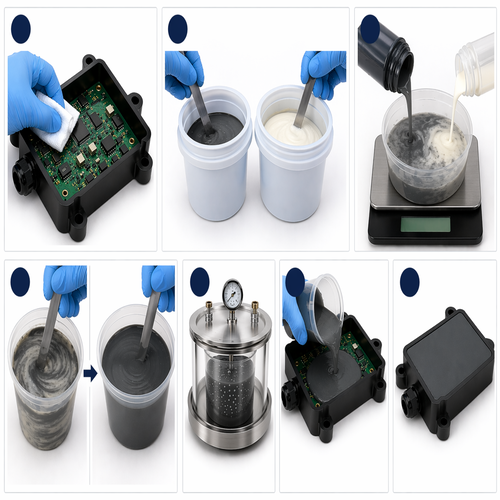
Figure 1.
Representative workflow of SFY-161 two-part silicone potting, including surface preparation, separate pre-stirring of Part A (dark gray) and Part B (off-white), 1:1 ratio measurement, complete mixing until uniform color, optional vacuum degassing, controlled pouring, and final opaque encapsulation.
Illustrations are representative application examples and actual processing conditions may vary depending on equipment, material volume, and reliability requirements.
When using SFY-161, process control affects final reliability because filler dispersion, mixing uniformity, and air entrapment may influence dielectric stability and long-term performance.
Step 1 – Surface Preparation
Clean and dry the housing or assembly before potting, because contaminants may reduce interface stability over time.
Step 2 – Pre-Stir Part A and Part B Separately
Stir Part A and Part B individually in their original containers before measurement, because filler settlement may affect mixing consistency and final material properties.
Step 2-1 – Measure at 1:1 Ratio
Measure the two components at the specified 1:1 ratio by weight or volume, because ratio deviation may result in incomplete curing or unstable mechanical behavior.
Step 3 – Mix Until Color Is Uniform
Mix thoroughly until the material becomes a consistent dark gray color, because incomplete mixing may leave localized soft spots or uneven crosslinking. Uniform color indicates mixing progress, but does not always guarantee complete dispersion, especially in larger batches or higher viscosity conditions.
Step 4 – Optional Vacuum Degassing
Vacuum degassing is recommended when bubble-free encapsulation is required, especially in thicker sections or high-reliability applications.
💡 Engineering Tip: Handling Deep Sections & Complex Geometries From our field experience, a single degassing cycle is often insufficient for modules with deep potting sections or intricate components. We strongly recommend a "Staged Vacuum Process": Perform an initial degassing of the mixed material before dispensing, followed by a secondary vacuum step once the module is filled. This ensures the silicone fully penetrates bottom corners and eliminates micro-bubbles that could otherwise evolve into cracks during long-term thermal cycling.
Step 5 – Controlled Pouring
Pour the mixed material into the enclosure in a controlled manner, because rapid pouring may trap air or disturb component positioning.
Step 6 – Self-Leveling and Cure
Allow the material to level and cure under defined conditions, because final performance depends on curing temperature, thickness, and potting geometry.
In applications involving complex geometries or deep potting sections, a staged vacuum process may help reduce air entrapment. This may include pre-degassing before dispensing and an additional vacuum step after filling, especially where trapped air at corners or bottom interfaces could affect long-term reliability. In practice, even small variations in mixing consistency or degassing effectiveness may lead to significant differences in long-term reliability, especially in high-density or vibration-exposed assemblies.
FAQ – Engineering Considerations
Q1: Can silicone potting prevent vibration-related failure?
To be blunt, there is no "one-size-fits-all" answer. While SFY-161 is engineered for stress absorption, silicone potting is not a magic fix for poor mechanical design. Its effectiveness depends heavily on the potting thickness, housing geometry, and overall system integration.
We have observed failure cases where the issue wasn't the material itself, but a potting layer that was too thin to effectively dampen vibration energy. We recommend evaluating "displacement space" early in the design phase rather than treating encapsulation solely as a surface coating.
Q2: Does UL 94 V-0 ensure long-term reliability?
No. UL 94 V-0 indicates flame retardancy, not long-term reliability.
Long-term performance depends on stress management, adhesion stability, and environmental resistance.
Q3: What is the main risk in potting applications?
Internal stress accumulation, thermal expansion mismatch, and void formation are the most common causes of failure.
These risks often develop over time and may not be visible during initial inspection.
Q4: What affects curing quality?
Mixing ratio, degassing, temperature, and material volume all influence curing completeness and final performance.
Incomplete mixing or air entrapment may lead to uneven curing or internal defects.
Technical Documentation & Compliance
👉 🔗 View Technical Data Sheet (TDS)
👉 🔗 View UL 94 V-0 Certification
Request Technical Evaluation
Material selection for encapsulation should be validated under actual operating conditions, including vibration, temperature cycling, and system geometry.
You Might Also Like


