Latest Products




Contact Us
- 2F. No.216-2, Zhongzheng Rd., Shulin Dist., New Taipei City 238, Taiwan
- fong.yong01@msa.hinet.net
- +886-2-26824939
Neutral-Cure RTV Silicone Sealant for PCB Connector Sealing & Localized Interface ProtectionHigh-Voltage RTV Silicone Sealant For Vibration-Critical Electronic Assemblies|SFR-3101
SFR-3101 is a neutral-cure RTV silicone sealant designed for localized sealing, connector protection, and electrical insulation. Suitable for precision dispensing and stable adhesion across mixed substrates.
Description
Fong Yong Chemical Co., Ltd. is one of the leading manufacturers and suppliers of neutral-cure rtv silicone sealant for pcb connector sealing & localized interface protectionhigh-voltage rtv silicone sealant for vibration-critical electronic assemblies|sfr-3101 in Taiwan. With abundant experience, we warmly welcome you to buy high quality customized products at competitive price from our factory. If you have any enquiry about quotation, please feel free to email us.
Page Overview
In electronic assemblies, failure often begins at exposed interfaces such as connectors, cable exits, or small gaps rather than across the entire system.
When these risk points remain unsealed after assembly, moisture ingress or electrical instability may develop even if the rest of the structure remains intact.
SFR-3101 is a neutral-cure RTV silicone sealant designed for this type of localized protection, where controlled dispensing, stable adhesion, and non-corrosive curing are more important than bulk material coverage.
Key Takeaways
- If failure occurs at connectors or exposed interfaces → localized sealing may be required instead of full encapsulation
- If moisture ingress originates from cable exits or gaps → controlled sealing at interface points becomes critical
- If mixed-material adhesion is required → neutral-cure silicone may reduce corrosion risk
- If full protection of internal components is needed → encapsulation systems should be evaluated instead
Where SFR-3101 Fits in Electronic Design
SFR-3101 is used in applications where protection is required at specific interface locations rather than across the entire device.
Unlike encapsulation materials that cover internal components, or perimeter sealants that define enclosure boundaries, localized sealing focuses on targeted protection of critical points.
Unlike epoxy encapsulation systems, which rely on rigid structural support, silicone-based localized sealing is designed to maintain flexibility at the interface. This allows the sealed area to accommodate thermal expansion differences between materials, reducing the risk of stress concentration at connector and component boundaries.
👉 In electronic assemblies, failure is often initiated at connectors, exposed conductors, or small interface gaps, where even minor discontinuities may lead to moisture ingress or electrical instability.
When to Use SFR-3101
·When connector pins or terminals remain partially exposed after assembly, increasing the risk of moisture ingress or electrical instability
·When cable exit points or wire interfaces show signs of leakage under humidity or temperature variation
·When different materials (such as metal housings and plastic connectors) require stable adhesion without introducing rigid stress
·When localized insulation or sealing is needed at specific interface points without covering the entire assembly
👉 In these situations, performance is often determined by how precisely the seal is applied and how well the interface is protected, rather than by bulk material properties.
When NOT to Use SFR-3101
When full encapsulation is required to protect internal components, because localized sealing does not provide internal structural protection
When sealing depends on maintaining a continuous barrier across large enclosure surfaces
When mechanical loads exceed sealant capability, as this product is not designed for structural bonding
👉 Localized sealing is intended for specific risk points, not full-system protection.
Failure Scenario
What causes failure in localized sealing applications?
Localized sealing failures are most commonly caused by incomplete coverage, inconsistent dispensing, or poor surface preparation rather than material breakdown.
In most cases, failure originates at exposed interfaces where sealing is incomplete or inconsistent, rather than from degradation of the material itself.
Typical failure patterns include:
- Incomplete coverage at critical points
Small gaps may allow moisture ingress or electrical leakage
- Inconsistent dispensing
Variations in bead size or placement may reduce sealing effectiveness
- Poor surface condition
Contamination may prevent stable adhesion at the interface
- Exposure at localized interfaces
Temperature variation and humidity may accelerate degradation at exposed points
👉 In localized sealing systems, reliability depends on precision, consistency, and interface control, not just material selection.
Hot Tags: neutral-cure rtv silicone sealant for pcb connector sealing & localized interface protectionhigh-voltage rtv silicone sealant for vibration-critical electronic assemblies|sfr-3101, suppliers, manufacturers, factory, customized, RTV 1 Electrically Insulative Silicone Caulk, One part Heat Transfer Electronics Silicone Glue, 1 Part Electronics Silicone Sealant, 1 part Rtv Neutral Cure Silicone Sealant Glue, One Part Silicone Sealant, White Automotive Heat Transfer Silicone Sealant
FAQ
Q: Can SFR-3101 be used for full potting applications?
A: No. SFR-3101 is designed for localized sealing and adhesion, not full encapsulation.
Q: What affects sealing performance at connectors?
A: Sealing performance is primarily affected by surface condition, dispensing consistency, and environmental exposure.
Q: Is SFR-3101 suitable for structural bonding?
A: No. It is not designed for structural bonding. Silicone sealants are typically used for fixing and sealing rather than load-bearing applications.
Q: What determines curing performance?
A: Curing performance depends on humidity, temperature, and applied thickness, and may vary depending on application conditions.
Q: What causes failure in localized silicone sealing?
A: Failures are most commonly caused by incomplete coverage, inconsistent dispensing, or poor surface preparation.
Material Behavior in Precision Sealing
SFR-3101 is a neutral-cure RTV silicone sealant designed for applications where non-corrosive curing and stable adhesion are required at localized interface points.
In precision sealing applications, material selection is often influenced by curing behavior, electrical insulation, and environmental stability.
Quick Reference for Engineering Evaluation
- Skin-over time: 5–15 minutes
Defines available working time for controlled dispensing
- Dielectric strength: 20 kV/mm
Supports insulation at exposed conductive interfaces
- Service temperature: -50°C to +200°C
Maintains sealing stability under thermal variation
- Flame retardancy: UL 94 V-0
Meets common safety requirements in electronic assemblies
👉 For detailed material properties and validation data, refer to the Technical Data Sheet.
👉 🔗 View TDS (Technical Data Sheet)
👉 These parameters are typically evaluated in relation to application geometry, interface design, and environmental exposure, rather than as standalone material specifications.
In localized sealing applications, curing behavior and dielectric performance often have a greater impact on long-term reliability than nominal material strength.
Application Workflow
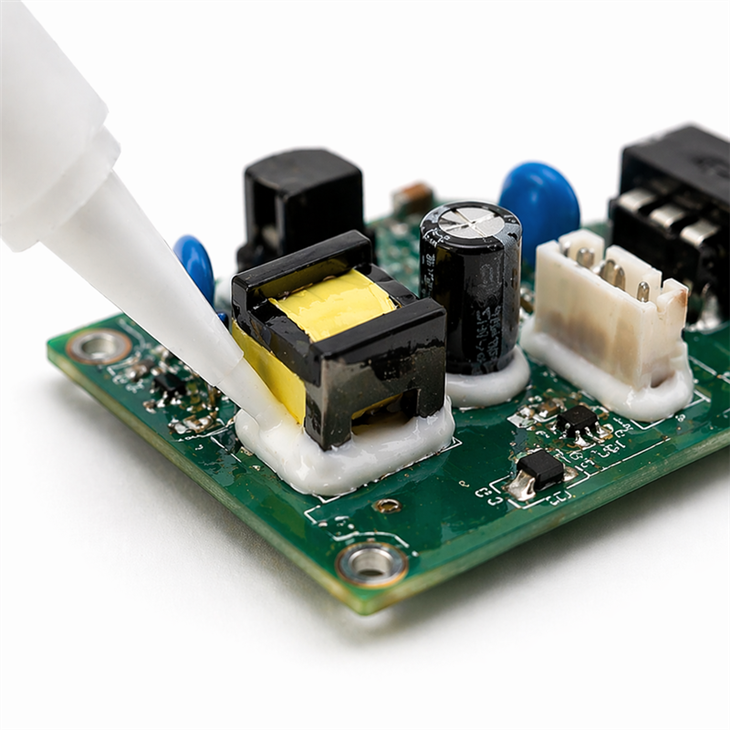
Localized silicone sealing requires controlled application rather than bulk material coverage. The process focuses on surface preparation, precise dispensing, and stable fillet formation at critical interface points.

Figure 1. Illustration of localized RTV silicone fixing and sealing workflow. The process highlights surface preparation, controlled dispensing, and final formation of a stable fillet around connector and component interfaces. Surface preparation → ensure clean and dry interface
1. Surface Preparation
Ensure the PCB surface, connector base, and component interfaces are clean and free of contaminants. Proper contact cleaning is essential to achieve stable adhesion.
2. Controlled Dispensing
Apply neutral-cure RTV silicone using a fine nozzle. The sealant should be dispensed directly at the interface, forming a continuous and controlled bead around the connector or component base.
3. Fixing & Sealing Formation
After application, the silicone settles into a defined fillet that stabilizes the component and seals the interface. The final structure should be smooth, continuous, and free of gaps.
When to Consider Localized Sealing
In many electronic assemblies, failure does not occur across the entire system.
Instead, it often originates at exposed interfaces such as connectors, cable exits, or small gaps that remain vulnerable after assembly.
In these situations, redesigning the entire structure or switching to full encapsulation may not be necessary.
👉 If failure is limited to specific interface points rather than internal components, localized sealing may be considered as a targeted solution.
👉 If moisture ingress or intermittent electrical instability is observed at connectors or exposed conductors, controlled sealing at these locations is often evaluated before applying bulk materials.
👉 If sealing is required without introducing rigid structural stress, flexible silicone-based materials may be used to maintain interface stability under thermal variation.
This approach allows design adjustments to focus on critical risk points rather than modifying the entire assembly structure.
In many cases, interface-level issues do not remain isolated.
If small gaps, incomplete sealing, or exposed interfaces are not addressed early, they may develop into intermittent system-level problems that are more difficult to diagnose over time.
For example, minor moisture ingress at connector interfaces may initially cause unstable signals, but can gradually lead to corrosion, insulation degradation, or unpredictable electrical behavior under repeated environmental exposure.
👉 Addressing sealing issues at the interface stage is often more effective than resolving failures after they propagate into the overall system.
If your application involves connector-level failure, cable exit leakage, or exposed interface gaps, early-stage material evaluation is recommended to verify sealing effectiveness under actual operating conditions.
For initial evaluation, testing small quantities under your specific assembly conditions is typically the most effective way to determine suitability before scaling to production.
FAQ
Q: Can SFR-3101 be used for full potting applications?
A: No. SFR-3101 is designed for localized sealing and adhesion, not full encapsulation.
Q: What affects sealing performance at connectors?
A: Sealing performance is primarily affected by surface condition, dispensing consistency, and environmental exposure.
Q: Is SFR-3101 suitable for structural bonding?
A: No. It is not designed for structural bonding. Silicone sealants are typically used for fixing and sealing rather than load-bearing applications.
Q: What determines curing performance?
A: Curing performance depends on humidity, temperature, and applied thickness, and may vary depending on application conditions.
Supply & Procurement Considerations
In production environments, material selection is not based on performance alone, but also on supply consistency, packaging compatibility, and handling conditions.
For localized sealing applications, procurement considerations may include packaging size, storage stability, and suitability for manual or automated dispensing processes.
👉 For initial evaluation, sample quantities are typically used to verify application behavior before scaling to production.
👉 Supply format, batch control, and production lead time are usually aligned with project requirements and confirmed during evaluation.
Technical Documentation & Compliance
For engineering evaluation, material selection is typically validated through small-scale testing under actual application conditions.
If you are evaluating localized sealing performance, sample quantities can be used to verify adhesion behavior, dispensing control, and interface stability before full implementation.
🔗 View TDS (Technical Data Sheet)
🔗 UL 94 V-0 Certification (E120665)
In production environments, material selection is often evaluated based on consistency, handling stability, and compatibility with existing assembly processes.
Supply conditions, packaging formats, and storage considerations may vary depending on application requirements and production scale.
👉 For procurement and engineering coordination, these factors are typically confirmed during evaluation to ensure alignment with manufacturing
conditions.
Related Product
👉 For applications focused on full encapsulation and internal protection:
🔗 Low-Stress Silicone Potting Compound for Vibration-Sensitive Electronics (SFY-161)
👉 For applications focused on enclosure sealing and perimeter protection:
🔗 RTV Silicone Sealant for HV Battery Sealing (SFR-8200)
You Might Also Like