

Latest Products



Contact Us
- 2F. No.216-2, Zhongzheng Rd., Shulin Dist., New Taipei City 238, Taiwan
- fong.yong01@msa.hinet.net
- +886-2-26824939


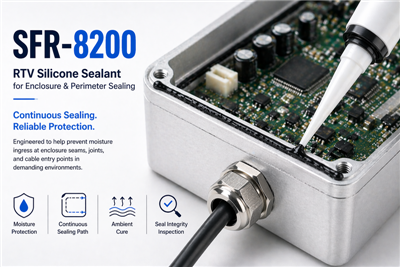

UL 94 V-0 Flame-Retardant RTV Silicone Sealant for Enclosure & Perimeter Sealing | SFR-8200
SFR-8200 is a one-part RTV silicone sealant with UL 94 V-0 rating (File E120665), 20 kV/mm dielectric strength, and a service range of −50°C to +200°C. Designed for enclosure seam sealing and cable entry protection in electrical and electronic applications.
Description
Fong Yong Chemical Co., Ltd. is one of the leading manufacturers and suppliers of ul 94 v-0 flame-retardant rtv silicone sealant for enclosure & perimeter sealing | sfr-8200 in Taiwan. With abundant experience, we warmly welcome you to buy high quality customized products at competitive price from our factory. If you have any enquiry about quotation, please feel free to email us.
| ✓ UL 94 V-0 Certified UL File No. E120665 | ⚡ Dielectric: 20 kV/mm | 🌡 −50°C to +200°C |
Product Overview
SFR-8200 is a one-part RTV silicone sealant with UL 94 V-0 flame-retardant classification (UL File No. E120665), designed for enclosure seam sealing and cable entry protection in electrical systems. It cures at room temperature without mixing, forming a flexible elastomeric barrier that resists moisture, condensation, and airborne contaminants.
In field applications, system failures often originate not from internal component breakdown, but from environmental ingress at external interfaces - enclosure seams, cable exits, and housing joints. Even gaps smaller than 0.5 mm can allow moisture entry under cyclic thermal expansion, which typically presents as intermittent insulation resistance drop before visible corrosion becomes detectable. SFR-8200 addresses this risk by forming a continuous, flexible sealing path along these boundaries without requiring structural modification or full encapsulation.
👉 🔗 Request Sample for Sealing Evaluation
|
📋 Key Takeaways • UL 94 V-0 flame-retardant rating at 3.0–3.3 mm (File E120665) - certified for electrical/electronic use • One-part RTV system - no pre-mixing, no catalyst, no heating required • Service temperature −50°C to +200°C - covers outdoor, HVAC, and industrial enclosure environments • • Dielectric strength 20 kV/mm - supports insulation at exposed cable entry and connector interfaces • Skin-over in 15–20 min - controlled working window for continuous bead formation |
Quick Procurement Snapshot
• Packaging: 300 mL cartridge
• Shelf life: 9 months (unopened, stored at ≤25°C in dry conditions, away from direct sunlight and high humidity).
• Available colors: White / Black
Where This Type of Sealing Is Used
Enclosure sealing targets the external boundaries of an assembly - the seams, joints, and penetration points where environmental exposure first occurs. In most designs, full internal encapsulation is not required or desirable; targeted perimeter sealing provides adequate protection at significantly lower material cost and process complexity.
Typical Application Locations
Housing seams and enclosure joints in control panels, junction boxes, and outdoor cabinets
Cable entry and exit points where conduit meets housing walls
Connector interfaces exposed to rain, condensation, or marine environments
Edge gaps between assembled components in transportation equipment (automotive, rail, marine)
Sensor and instrument housings requiring environmental sealing without structural adhesion
Why UL 94 V-0 Flame Retardancy Matters for Enclosure Sealing
In electrical enclosures and electronic assemblies, the sealant at the perimeter is in direct contact with the outer housing, often near cable entries or terminal openings. In the event of an internal fault, a non-flame-retardant sealant at these interfaces can become an ignition path. UL 94 V-0 classification requires the material to self-extinguish within 10 seconds after each flame application and produce no flaming drips - the most stringent category in the UL 94 horizontal and vertical burning test series.
SFR-8200 achieves UL 94 V-0 at a thickness of 3.0–3.3 mm, as documented under UL File No. E120665. This rating is maintained across all available colors (white and black).
Application Fit: When to Use and When Not to Use
|
✅ Recommended for: • Enclosure perimeter sealing against moisture and condensation • Cable entry and exit point sealing on electrical panels • Connector and gland interfaces in outdoor or marine environments • Sealing housing joints on transportation equipment • Applications requiring UL 94 V-0 flame retardancy at the sealant interface • Production or field installation where pre-mixing would reduce throughput |
✗ Not recommended for: • Full potting or internal encapsulation (use a potting compound) • Structural or load-bearing adhesion (Shore A 65 is insufficient for mechanical loads) • Closed-type polycarbonate (PC) substrates - use a PC-compatible non-corrosive sealant • Applications requiring cure times under 6 hours at full section thickness • Substrates with active oils, waxes, or mold releases without prior cleaning |
Common Failure Modes in Enclosure Sealing
Sealing failures in enclosures are rarely caused by material degradation alone. Most field failures trace back to process or design issues that can be anticipated during the evaluation phase.
|
⚠ Discontinuous sealing path Gaps at inside corners or cable transitions - even openings of 0.5 mm allow moisture ingress under cyclic thermal expansion. This presents as intermittent insulation resistance drop (often 10–100× reduction at humidity peaks) before visible corrosion develops. Inspect all corners and cable glands with a calibrated feeler gauge or low-voltage wetting current test after cure. |
|
⚠ Incomplete surface preparation Residual oils, fingerprints, or flux contamination reduce adhesion strength. In cyclic thermal environments, adhesion failure at contaminated zones creates a peeling path that wicks moisture along the interface. Solvent-wipe all contact surfaces immediately before application. |
|
⚠ Premature skinning at elevated temperatures In environments above 35°C, skin-over time may shorten to 8–12 minutes. Rushing bead application without adjusting nozzle speed leads to surface-to-surface joins rather than a monolithic bead. In hot environments, work in shorter sections and inspect joins immediately. |
|
⚠ Insufficient cure depth before assembly closure Closing the enclosure lid onto an incompletely cured bead compresses the bead before through-cure, creating a deformed cross-section with reduced effective seal width. Allow minimum 4 hours before closure, or validate cure depth with a thumb-press test (bead should not deform permanently). |
Technical Documentation & Compliance
|
Certification / Document |
Details |
Access |
|
UL 94 V-0 Certification |
UL File No. E120665 · Thickness 3.0–3.3 mm · All colors · Report date 2007-08-27, revised 2015-01-14 |
|
|
Technical Data Sheet (TDS) |
Full specification table · Application instructions · Storage & shelf life · Safety precautions |
Supply & Procurement Information
|
Standard Packaging |
300 mL cartridge (manual / pneumatic dispensing compatible) |
|
Available Colors |
White · Black |
|
Shelf Life |
9 months (unopened, stored at ≤25°C in dry conditions, away from direct sunlight and heat sources). |
|
Lead Time |
10–14 days after order confirmation (made-to-order) |
|
Documentation |
UL Certification (File No. E120665) · Technical Data Sheet (TDS) available for internal review |
👉 🔗Request Pricing & Delivery Details
Hot Tags: ul 94 v-0 flame-retardant rtv silicone sealant for enclosure & perimeter sealing | sfr-8200, suppliers, manufacturers, factory, customized, One Component Silicone Rubber Adhesive, One Component Silicone, Water Resistant Silicone Adhesive, Rtv1 Electrical Insulating Silicone, Rtv 1 Alkoxy Electronic Silicone Sealant, 1 Part Electronics Silicone Sealant
Material Properties & Typical Specifications
|
Property |
Typical Value |
Engineering Relevance |
|
Appearance |
High viscous liquid |
|
|
Color |
White or black |
|
|
Viscosity (25°C) |
120,000–380,000 cps |
Controlled bead formation; minimal slump on vertical surfaces |
|
Specific Gravity (25°C) |
1.48 |
|
|
Skin-Over Time (25°C) |
15–20 minutes |
Working window for continuous bead application |
|
Cure Time (3 mm, 25°C) |
~24 hours |
Thicker sections or low humidity require longer cure time |
|
Hardness (Shore A) |
65 |
Flexible elastomer; accommodates thermal expansion differential |
|
Tensile Strength |
150 psi |
|
|
Elongation |
~100% |
Maintains sealing integrity under joint movement |
|
Dielectric Strength |
20 kV/mm |
Electrical insulation at exposed enclosure interfaces |
|
Volume Resistivity |
2 × 10¹⁴ Ω·cm |
Supports insulation performance in humid environments |
|
Thermal Conductivity |
0.5 W/m·K |
|
|
Thermal Expansion Coeff. |
200 ppm/°C (5–150°C) |
Relevant for joint sizing in thermal cycling environments |
|
Service Temperature |
−50°C to +200°C |
Outdoor, engine bay, HVAC, industrial enclosures |
|
Flame Retardancy |
UL 94 V-0 |
Certified at 3.0–3.3 mm, UL File No. E120665 |
👉🔗 Download full TDS (PDF) for complete test data and processing conditions
👉 🔗 View UL Certification (File E120665)
Batch Consistency Consideration
Lot-to-lot variations in viscosity and curing behavior may occur within specification limits.
For applications requiring stable dispensing performance or tight process control, pre-production validation using representative samples is recommended prior to initial lot approval.
Application Workflow - Enclosure Sealing

Figure 1. RTV silicone sealing workflow: continuous enclosure sealing path formation to reduce moisture ingress at interface boundaries. Illustrations are representative and do not depict specific customers or brands.
Step 1 Surface Preparation
Clean and dry all enclosure seams, cable entry holes, and connector interfaces. Remove dust, oil, flux residue, and release agents. Use an appropriate solvent (IPA recommended for metal substrates). Allow surface to dry completely before application. Inadequate surface preparation is the leading cause of adhesion failure in field installations.
Step 2 Nozzle Preparation & Controlled Dispensing
Cut cartridge tip to match required bead diameter (typically 4–6 mm for perimeter sealing). Apply SFR-8200 along enclosure interfaces using a caulking gun at a consistent angle (45°) and steady feed rate. Maintain continuous contact between nozzle and substrate. Do not stir material - this traps air bubbles that disrupt bead continuity.
Step 3 Continuous Sealing Path Formation
Ensure the bead is unbroken along the entire interface perimeter, including corners, transitions, and cable exit points. At inside corners, tool the bead into the corner with a wetted spatula. Gaps as small as 0.5 mm can become moisture ingress points under thermal cycling - inspect corners and transitions carefully.
Step 4 Ambient Curing
Allow cure at ambient conditions (≥40% RH, 25°C recommended). Surface skin forms in 15–20 minutes - avoid disturbing the bead during this period. Full cure through a 3 mm section requires approximately 24 hours. Lower humidity, lower temperature, or greater bead thickness all extend cure time. Do not force-dry with heat guns; this can skin the surface before through-cure occurs.
Step 5 Sealing Integrity Inspection
After full cure, visually inspect the sealing path for continuity, uniform bead width, and full contact at substrate boundaries. Pay particular attention to inside corners, cable glands, and enclosure door frames. For critical applications, post-cure low-voltage insulation resistance testing can confirm sealing effectiveness.
Next Steps
If sealing performance needs to be verified under actual conditions, the following steps are typically taken.
|
🔬 Engineering Evaluation Request a sample cartridge for application testing in your assembly environment. 👉 🔗 Request Sample for Sealing Evaluation |
🔧 Technical Support Discuss substrate compatibility, application process, or specification requirements with our technical team. 👉 🔗 Discuss Your Sealing Application |
Procurement Ready to place an order or need a formal quotation for your procurement process? 👉 🔗 Request Pricing & Delivery Details |
FAQ
Q: What is the UL 94 V-0 rating of SFR-8200, and at what thickness does it apply?
A: SFR-8200 achieves UL 94 V-0 flammability classification at a thickness of 3.0–3.3 mm, as certified under UL File No. E120665 (Fong Yong Chemical Co. Ltd.). The rating applies to all available colors (white and black). UL 94 V-0 requires self-extinguishing within 10 seconds per flame application with no flaming drip.
Q: What is the service temperature range of SFR-8200?
A: SFR-8200 maintains sealing performance from −50°C to +200°C. This covers outdoor panel enclosures, automotive underhood environments, marine applications, HVAC system housings, and industrial ovens. Wide-range temperature capability is critical for seals that must remain elastic through thermal expansion and contraction cycles.
Q: How does SFR-8200 compare to two-part silicone sealants for enclosure sealing?
A: SFR-8200 is a one-part system requiring no pre-mixing, catalyst preparation, or pot-life management. Two-part systems offer higher crosslink density and may cure faster in thick sections, but introduce process risk from improper mix ratios. For perimeter sealing where section thickness is typically under 5 mm, one-part RTV provides equivalent sealing performance with lower application complexity.
Q: What is the dielectric strength, and what voltage level does this support?
A: Dielectric strength is 20 kV/mm (typical at 25°C). For a 3 mm bead cross-section, this equates to an estimated withstand voltage of approximately 60 kV under ideal conditions. In practical low-to-medium voltage enclosures (up to 1,000 V AC), SFR-8200 provides substantial dielectric margin at cable entry and connector interfaces.
Q: Is SFR-8200 suitable for polycarbonate (PC) enclosures
A: SFR-8200 is not recommended for use on closed-type polycarbonate (PC) substrates. Some RTV silicone systems release acetic acid during cure, which can stress-crack PC. If your enclosure is PC, specify a neutral-cure or non-corrosive silicone sealant and verify compatibility with a small coupon test before production use.
Q: What affects cure time, and how can I accelerate it?
A: SFR-8200 cures by reaction with atmospheric moisture. Cure rate increases with higher relative humidity (above 60% RH), warmer temperature (above 25°C), and thinner section. A 3 mm bead at 25°C / 50% RH typically skins in 15–20 minutes and fully cures in 24 hours. In low-humidity or cold environments, cure time may extend to 48–72 hours. Gentle humidification of the workspace (not direct water contact) can accelerate cure.
Q: What is the standard packaging, and what is the shelf life?
A: SFR-8200 is supplied in 300 mL cartridges, compatible with standard caulking guns. Shelf life is 9 months from date of manufacture, in unopened containers stored at ≤25°C in dry conditions, away from direct sunlight. Once opened, reseal tightly with the original cap and use remaining material promptly. Partially-used cartridges that have skinned at the tip should be cut back to fresh material before reuse.
Q: Can SFR-8200 be used in marine or outdoor environments?
A: Yes. SFR-8200 exhibits good weather resistance, including UV, humidity, and salt spray exposure, consistent with silicone-based sealants. Its service temperature range accommodates seasonal thermal cycling. For marine applications, ensure thorough surface preparation to remove salt contamination before application.
Disclaimer
The property values presented on this page are typical values obtained under laboratory conditions and are provided for general reference only. Actual performance depends on application conditions including substrate type, surface preparation, applied thickness, ambient temperature, humidity, and curing conditions. Fong Yong Chemical Co., Ltd. assumes no obligation or liability for results obtained in any specific application. Users are solely responsible for evaluating product suitability for their intended use. Sample testing under production conditions is recommended before full-scale implementation.
Fong Yong Chemical Co., Ltd. 2F., No.216-2, Zhongzheng Rd., Shulin Dist., New Taipei City 23867, Taiwan (R.O.C.) TEL: +886-2-2682-4939 | FAX: +886-2-2683-4333
You Might Also Like


