

A clear epoxy casting that looked optically perfect in the mold - smooth surface, no bubbles, good clarity - can emerge cracked, yellowed, or warped. The defect was not caused by anything that happened after demoulding. It was already determined during the cure, by a process that standard visual monitoring cannot detect. Understanding why requires understanding one property of two-component epoxy that is often overlooked until a casting fails: it generates heat.

Figure 1. Side-by-side cross-section diagram comparing heat behavior in thin epoxy casting (3mm, heat arrows escaping outward, green temperature zone - low exotherm risk) versus thick epoxy casting (30mm, heat arrows trapped in center, red hot zone with temperature accumulation label - high exotherm risk causing cracking, yellowing, and distortion)
My Casting Looked Perfect Yesterday. Why Did It Crack Today?
The answer is almost always the same: the casting generated more heat than it could release, and that heat either drove the cure too fast, raised the internal temperature above the resin's thermal tolerance, or created stress gradients as different zones of the casting cured at different rates. The crack that appeared after demoulding was present - as internal stress - before the casting was removed from the mold. Demoulding released the constraint that was holding it together.
This is why the defect pattern can be surprising: the surface looked fine, the resin felt cured, the mold showed nothing unusual. The failure mechanism operated inside the casting volume, where temperature cannot be monitored by surface observation.
Why Clear Epoxy Generates Heat While Curing
Two-component epoxy cures through a chemical reaction between the resin and hardener components. This reaction - polymerization - is exothermic: it releases energy as heat. The heat generation is not a processing defect or a mixing error. It is inherent to the chemistry. Every two-component epoxy system generates heat during cure; the only variable is how much, and whether the casting geometry allows that heat to escape fast enough.
In a thin film or surface coating, the heat generated by the reaction dissipates rapidly through the large surface area relative to the small resin volume. The temperature rise is small and the effect on the cured film is negligible. In a thick casting, the situation changes: the resin volume is large, the surface area available for heat dissipation is proportionally small, and the heat generated accumulates inside the mass faster than it can escape.
Why Thick Castings Trap Heat - The Volume-to-Surface Ratio
The key variable is the ratio between the volume of resin generating heat and the surface area available to release it. In a thin casting, nearly every part of the resin mass is close to a surface - heat has a short path out. In a thick casting, the center of the mass is far from any surface. The heat generated at the center has nowhere to go quickly.
As pour depth increases, this ratio changes unfavorably: volume grows as the cube of the linear dimension while surface area grows only as the square. A casting that is twice as deep has roughly eight times the volume but only four times the surface area - meaning the heat per unit of available dissipation surface has doubled. This is why the relationship between pour depth and exotherm risk is not linear. Doubling the pour depth more than doubles the thermal risk.
The exotherm is also self-amplifying: heat accelerates the cure reaction, which generates more heat, which accelerates the cure further. In a thin film, this feedback loop is minor. In a large-volume casting, it can drive the center temperature to levels that exceed the resin's thermal tolerance before the surface has fully cured.
The Three Exotherm Failure Modes: Cracking, Yellowing, and Distortion
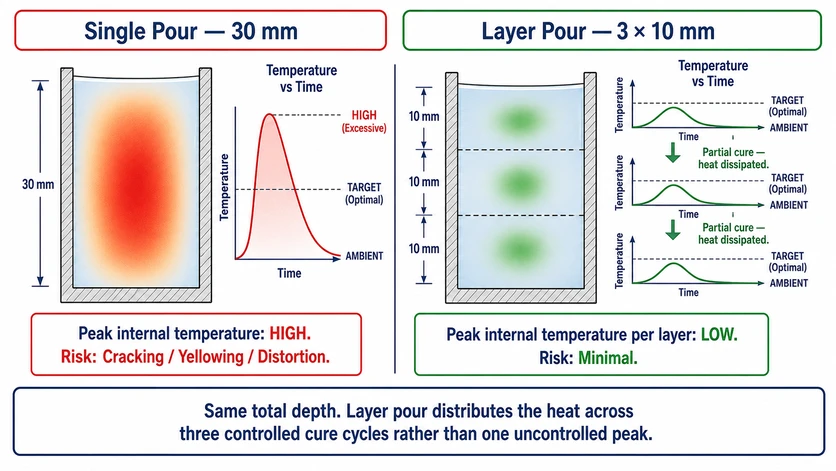
Figure 2. The crack that appears after demoulding was already present as internal stress before the mold was opened. Demoulding releases the constraint - it does not cause the failure.
Why One User Can Pour 20 mm Successfully While Another Cannot
Exotherm severity is not determined by pour depth alone. Several variables shift the threshold at which a given pour depth becomes problematic:
- Ambient temperature. At higher ambient temperatures, the resin is already closer to its peak reaction temperature at the start of the pour. The same pour depth at 30°C generates a significantly higher peak internal temperature than the same pour at 20°C. A 20 mm pour that was manageable in a climate-controlled workshop may produce exotherm failure when the same process is repeated in summer conditions.
- Mixing ratio accuracy. Off-ratio mixing - even slightly - affects cure kinetics. In most cases, off-ratio mixing slows the cure and reduces peak exotherm. Precisely on-ratio mixing at the recommended ratio produces the highest peak exotherm for a given pour volume. This is why informal tests at approximate ratios may succeed where precise production mixing at the correct ratio fails.
- Mold geometry and material. A deep, narrow mold traps heat more efficiently than a shallow, wide mold of the same volume - because the depth-to-surface ratio is higher. Silicone molds are thermally insulating; metal molds conduct heat away from the casting. The same resin volume in a silicone mold accumulates more heat than in an aluminum mold.
- Resin temperature at mixing. Resin and hardener stored in a warm environment are at elevated temperature before mixing. The initial temperature of the mix affects how quickly the exotherm peak is reached and how high it goes.
The result: a pour depth that is safe under one set of conditions can produce exotherm failure under a different combination of ambient temperature, mold geometry, and mixing conditions. Success in a previous pour at the same depth is not a guarantee that the same depth is always safe.
Layer Pouring Is Not About Thickness - It Is About Heat Control
Layer pouring - dividing a thick casting into multiple sequential pours, each allowed to partially cure before the next is added - is sometimes described as a thickness rule: "pour no more than X mm at a time." This framing is correct in practice but misses the underlying principle. The limit on pour depth per layer is not arbitrary; it is derived from the volume-to-surface ratio at which exotherm heat can dissipate without accumulating to a damaging level.
What layer pouring actually controls: each individual layer has a favorable volume-to-surface ratio. The heat it generates dissipates before the next layer is added. The cumulative heat of the full-thickness casting is spread across multiple cure cycles rather than concentrated in a single exotherm event. The finished casting achieves the same total depth with a fraction of the peak internal temperature.
The timing between layers matters. The previous layer should be partially cured - firm but not fully hardened - before the next pour. Adding a new layer to a fully cured previous layer creates a bond line; adding to a partially cured layer achieves a chemical bond across the pour interface. The specific timing depends on the resin formulation, ambient temperature, and layer thickness.
Engineering Decision Summary
| Casting Situation | Exotherm Risk | Recommended Approach |
|---|---|---|
| Thin decorative surface coating | Low | Single application - heat dissipates readily |
| Small casting - jewelry, thin pendants | Low–Medium | Single pour typically manageable; verify on sample casting at intended ambient temperature |
| Medium decorative casting | Medium | Control pour volume and ambient temperature; layer pouring recommended for consistent results |
| Thick casting or embedded object | High | Layer pouring required; cool ambient conditions preferred; do not rush inter-layer timing |
| Large mass casting or deep encapsulation | Very High | Process validation required before production; layer pour with extended inter-layer cure time; ambient temperature control |
Frequently Asked Questions
Q: Why does clear epoxy crack after pouring into a thick mold?
Cracking in thick epoxy castings is caused by internal stress from differential cure rates driven by exotherm heat accumulation. The center of the casting cures first - it is hottest - while the outer zones cure more slowly. As the center contracts during cure shrinkage, it creates stress in the still-soft outer zones. When those zones cure and harden, they lock in the stress differential. The crack either appears while still in the mold or develops when demoulding releases the geometric constraint. The larger the casting volume and the higher the ambient temperature, the more pronounced the differential cure and the higher the internal stress.
Q: Why did my epoxy casting turn yellow or brown after curing?
Yellowing and browning in a clear epoxy casting are thermal discoloration - the result of the internal casting temperature rising above the resin's thermal degradation threshold during the exotherm peak. This can occur even at normal ambient temperatures when the casting volume is large enough to accumulate heat faster than it dissipates. The discoloration is caused by chemical changes in the cured resin matrix, not by UV exposure or surface contamination, and it is permanent. Prevention requires controlling pour volume per layer so that the peak internal temperature stays within the resin's rated range throughout the cure.
Q: What causes warping and distortion in thick epoxy castings?
Warping and distortion in thick castings result from uneven cure rates across the casting depth. When the center cures faster than the outer zones - due to exotherm heat accumulation - the differential shrinkage generates internal stress. The mold holds the casting in shape during cure; when released, the locked-in stress produces a casting that bows, warps, or shows dimensional variation across the pour depth. The thicker the casting, the more pronounced the cure rate differential and the higher the distortion risk.
Q: How does ambient temperature affect epoxy casting exotherm risk?
Ambient temperature directly affects the starting temperature of the resin mix and the rate of the curing reaction. Higher ambient temperature means the resin is already closer to its peak reaction temperature before the pour begins. The exotherm peak is reached faster and the absolute peak temperature is higher. A pour depth that is manageable at 20°C can produce cracking, yellowing, or distortion at 30°C - because the same volume of resin generates the same heat but starts at a higher baseline, so the peak is proportionally higher. Working in cooler ambient conditions - or cooling the resin components before mixing - is one of the most effective interventions for controlling exotherm in thick-section casting.
Q: Need a clear resin system for casting applications?
Evaluate our casting resin for jewelry, decorative castings, botanical embedding, and clear artistic components: → E-1001 / H-1001 Crystal Clear Epoxy Resin - Art Casting, Jewelry Making, and Decorative Embedding
Looking for a clear laminating resin instead of a casting resin?
If the resin will be applied as a thin coating or decorative laminate over carbon fiber, fiberglass, or rigid decorative surfaces - rather than poured into a mold - evaluate our surface coating resin: → E-126 / H-100 Hard Clear Epoxy Coating Resin - Fiberglass, Keychains, and Rigid Decorative Surfaces


