


Figure 1. Delayed cracking in epoxy potting typically initiates at component edges and lead exits - not at the outer surface. The assembly passes all initial tests; the failure appears after 50–200 thermal cycles in service.
The assembly passes all qualification tests. Hi-pot: pass. Visual inspection: clean. Thermal shock at –40°C to +85°C, 50 cycles: pass. It ships. Fourteen months later, the first field returns arrive - hairline cracks at the potting-to-housing interface, delamination at the lead exit points, intermittent opens on units that measured clean at shipment. The engineering team requests cross-sections. The cracks are in the epoxy potting, not in the components. The cure schedule in the production record is listed correctly. The material has not changed. The investigation closes as "material fatigue - within expected service life variability."
It is not material fatigue. It is residual stress, set during cure, that was never measured and never appeared in the qualification sequence - because the qualification did not include the thermal cycles that were needed to release it. Delayed cracking in thick-section epoxy potting is almost always a curing process defect, not a material defect. The crack is created during cure. It appears in the field.
The Exotherm Mechanism: Why Thick Sections Cure Differently from Thin Ones
Epoxy cross-linking is an exothermic reaction. When resin and hardener combine and the mixture is exposed to heat, the reaction generates its own heat in addition to absorbing heat from the oven. In a thin specimen - the type used for UL material testing - the self-generated heat dissipates rapidly to the oven atmosphere through the large surface-to-volume ratio. The specimen temperature closely tracks the oven setpoint throughout the cure cycle.
In a thick potted section - a transformer core with a 20 mm pour, a power module with a 25 mm fill depth - the surface-to-volume ratio is much lower. Heat from the exothermic reaction at the core of the section has a long diffusion path to the surface, and the surrounding resin that has not yet fully reacted acts as thermal insulation. The core temperature overshoots the oven setpoint. In a single-stage 120°C cure of a 20 mm section, core temperatures of 140–165°C are not unusual, even when the oven is set at 120°C and the surface of the part measures 120°C with a surface thermocouple.
This overshoot matters because the rate of cross-linking increases sharply with temperature. The core of the section, running 20–45°C above the oven setpoint, completes its primary cross-linking significantly faster than the outer material. The cross-link network in the core is effectively "frozen" into position while the outer layers are still reacting. When the assembly cools after cure, both regions contract thermally - but they contract from different starting points and at different rates, because the core is already a rigid glassy solid while the outer layers are completing their network formation.
The result is a locked-in stress state in the fully cured part: residual tensile stress in the outer material and residual compressive stress in the core. This is not a hypothesis - it is a well-characterized phenomenon in thick-section thermoset processing, analogous to the residual stress in rapidly quenched glass.

Figure 2. In a single-stage 120°C cure of a 20 mm section, the core temperature routinely exceeds the oven setpoint by 20–45°C during the cross-linking exotherm. The two-stage profile limits this overshoot by initiating cross-linking at 80°C before the higher-temperature stage is applied.
Why the Assembly Passes Initial Testing
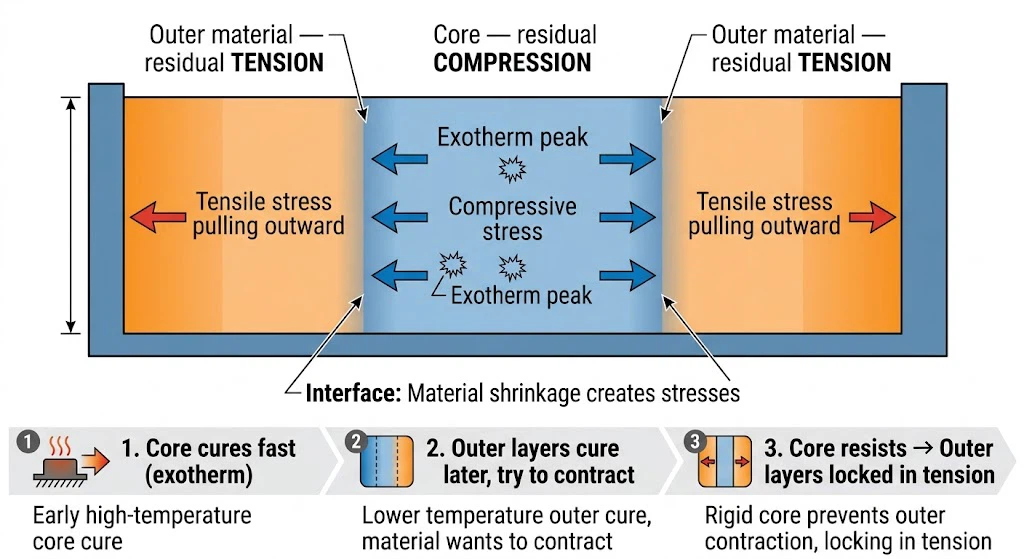
Figure 3. After a single-stage high-temperature cure, the cured section carries a locked-in stress state: residual tension in the outer layers, residual compression in the core. This stress state adds to the cyclic thermal stress in service, accelerating fatigue crack initiation.
The residual tensile stress in the outer potting material from a single-stage thick-section cure is typically below the ultimate tensile strength of the epoxy at room temperature. The fully cured part does not crack during cure - or if it does, the micro-cracks are below the detection threshold of visual inspection. Hi-pot testing at the rated voltage passes because the effective dielectric strength of the slightly stressed matrix is not significantly different from the unstressed reference.
The problem reveals itself under thermal cycling, and the mechanism is straightforward: each thermal cycle from low temperature to high temperature generates cyclic tensile and compressive stress in the potting material, driven by the CTE mismatch between the epoxy, the embedded components, and the housing. At the stress concentration sites - corners, edges of components, lead exit points, and the potting-to-housing interface - the cyclic stress amplitude is highest. The residual tensile stress from cure adds directly to the cyclic tensile stress at these locations, because both are tensile stresses that act in the same direction during the thermal cycle's heating phase.
The combined stress amplitude - residual cure stress plus cyclic thermal stress - may still be below the ultimate tensile strength of the epoxy on the first cycle. It reaches the fatigue crack initiation threshold after a number of cycles that depends on the specific residual stress magnitude, the CTE mismatch, the thermal cycle amplitude, and the geometry of the stress concentrator. This is why the failure appears after 50–200 cycles, not at initial testing. It is not material degradation over time - it is stress accumulation to a threshold.
Why This Failure Is Systematically Misidentified
When a field failure investigation finds cracks in epoxy potting material, several misidentifications are common:
"Material fatigue" - the epoxy failed in fatigue, implying the material was inadequate for the application. The actual mechanism is stress accumulation from a combination of residual cure stress and cyclic thermal stress. Changing to a different epoxy material without changing the cure process will replicate the failure, because the residual stress mechanism is process-dependent, not material-dependent.
"Thermal shock damage" - the assembly was exposed to an unusually severe thermal event. This is sometimes true, but crack patterns from thermal shock typically initiate at the outer surface and propagate inward. Residual stress cracks typically initiate at internal geometry features (component edges, lead exits) and propagate outward. The crack origin location distinguishes the two mechanisms on cross-section.
"Insufficient potting adhesion" - the epoxy did not bond well to the substrate or housing. Delamination at the potting-housing interface can result from inadequate surface preparation, but it can also result from residual tensile stress exceeding the interfacial bond strength. The latter requires no surface preparation failure - it occurs on clean, correctly prepared surfaces when the residual stress is sufficiently high.
"Component quality" - a component lead or termination failed. In cases where the crack propagates to a component interface, the crack appearance can be misidentified as a component failure. Cross-section analysis distinguishes between a crack that initiated at the component and one that propagated to it from the surrounding epoxy.
In most of these misidentifications, the cure process record is not reviewed as part of the failure investigation. The cure schedule listed in the production traveler matches the specification - because the specification lists the oven setpoint and programmed duration, not the temperature actually achieved at the core of the potted section. The residual stress mechanism is invisible in the production record.
The Two-Stage Cure Profile: How It Reduces Residual Stress
The two-stage cure profile addresses the exotherm mechanism directly by dividing the cross-linking reaction into two controlled stages:
Stage 1 at 80°C initiates the cross-linking reaction at a lower temperature, where the reaction rate is slower and the exothermic heat generation per unit time is lower. At 80°C, the system begins to build cross-link density - enough to prevent the rapid acceleration of reaction rate that would occur if the system were immediately exposed to 120°C. The lower initial reaction rate reduces the self-generated exotherm, keeping the core temperature closer to the oven setpoint. The cross-link density develops more uniformly across the section depth during Stage 1.
Stage 2 at 120°C then drives the system to full cure. By the time Stage 2 begins, the Stage 1 network has already developed enough rigidity to limit the additional exotherm during Stage 2. The remaining cross-linking occurs in a network that is partially constrained by the Stage 1 structure, and the temperature differential between core and surface during Stage 2 is substantially reduced compared to a single-stage 120°C cure.
The result is a cured section with lower residual tensile stress in the outer material. The assembly still has some residual stress - no cure process eliminates it entirely - but the magnitude is reduced enough that the combined amplitude of residual stress plus cyclic thermal stress stays below the fatigue crack initiation threshold for a significantly longer service life.
This is not a theoretical argument. It is observed empirically: assemblies that experienced delayed cracking with a single-stage 120°C cure on the same potting material have shown extended service life after switching to a two-stage profile, without changing the material, geometry, or any other process parameter. The cure schedule is the variable.
The Critical Gap in Qualification Testing
Standard qualification test sequences for potted assemblies typically include a limited number of thermal cycles - 50 to 100 cycles is common in IEC and UL standards for the specific equipment categories. A thick-section potted assembly with residual stress from a single-stage cure may pass 50 or even 100 thermal cycles before the cumulative stress reaches the crack initiation threshold. When the failure occurs at 150–200 cycles in service - which may correspond to 12–18 months of operation at one or two thermal cycles per day - the qualification sequence did not expose it.
This is a systematic gap: the qualification was correctly performed, the test passed, but the failure mode operates on a longer cycle scale than the test covers. Designs where the cure process introduces residual stress require either a longer qualification thermal cycle sequence, or a cure process that reduces the residual stress to a level where the standard qualification cycle count is genuinely predictive of service life.
The two-stage cure profile reduces the residual stress magnitude, which reduces the total stress amplitude per cycle. This, combined with the same thermal cycle count in the qualification sequence, provides genuine assurance rather than assurance that is limited by the test's inability to reveal the failure mode.
Identifying Whether a Current Design Is at Risk
The following design and process conditions indicate elevated residual stress risk in thick-section epoxy potting:
Potting section depth exceeds 10 mm in any dimension.
Current cure schedule is single-stage at 100°C or above.
No thermocouple monitoring of core temperature during cure - only surface or oven air temperature is recorded.
Failure history shows cracks appearing after multiple thermal cycles in service, with assemblies passing initial inspection.
Crack origin locations on cross-section are at component edges, lead exits, or internal geometry features - not at the outer surface.
Qualification thermal cycle count was 50 cycles or fewer, and service life is expected to involve 200 or more thermal cycles.
A practical verification step is to produce test specimens at the actual production section thickness and cure schedule, embed a thermocouple at the center of the section, and record the actual core temperature profile during cure. If the core temperature significantly exceeds the oven setpoint during the cross-linking phase, the exotherm mechanism is active and residual stress is being generated.
HDT, Tg, and RTI: The Thermal Properties That Define Operating Envelope
A two-stage cure profile, properly executed, produces a cured material with the full rated thermal properties: Tg 117.8°C by TMA (ASTM E831), HDT 130°C, RTI 130°C under UL File E120665. These values define the operating envelope for the cured assembly:
Tg 117.8°C - the glass transition temperature measured by thermomechanical analysis; use this for CTE budget calculations and dimensional stability analysis. Above Tg, the CTE increases from 49.772 ppm/°C (α1, below Tg) to 148.482 ppm/°C (α2, above Tg) - approximately a 3× increase.
HDT 130°C - the temperature at which the cured material deflects under a standard 1.8 MPa load; use this for mechanical load-bearing at elevated temperature.
RTI 130°C - UL's rating for continuous electrical and mechanical property retention; designs requiring continuous service above 90°C that are outside the rating of E532/H532 (RTI 90°C) are within E536/H536's rating.
These thermal property values are only achieved when the two-stage cure is properly completed. An assembly that received Stage 1 only - or Stage 1 at insufficient temperature - will have Tg and HDT below these values. Witness specimens cured alongside production batches and tested for HDT provide a practical process verification: a measured HDT substantially below 130°C indicates incomplete Stage 2 cure.
Related Product for Thick-Section Potting with Curing Stress Control
E536/H536 is a two-component, UL 94 V-0 flame-retardant epoxy potting compound engineered specifically for thick-section applications where curing stress is the primary failure mechanism. Its two-stage cure profile (80°C × 2 hrs + 120°C × 4 hrs) limits core exotherm during Stage 1 and achieves full property development in Stage 2. RTI 130°C, HDT 130°C, Shore D 89, and minimum UL certified thickness of 1.58–1.74 mm (black colorway) under UL File E120665.
It is not appropriate for applications requiring thermal conductivity above 0.5 W/m·K (use E533/H533 for that) or for room-temperature cure production environments (use E532/H532 for that). The two-stage cure profile requires oven capability at both 80°C and 120°C with controlled ramp and hold times.
→ 🔗E536/H536 Product Page - Technical Data, TMA Test Report, Application Notes
Key Engineering Questions
How do I know whether my current assembly has residual stress from its cure process?
The direct method is to embed a thermocouple at the center of the potting section and record core temperature during cure. If the core temperature exceeds the oven setpoint by more than 10–15°C during the cross-linking phase, residual stress is being generated. The indirect method is to perform accelerated thermal cycling to a cycle count significantly higher than the qualification sequence (e.g., 500 cycles) and inspect for crack initiation sites. Cracks that initiate at internal geometry features rather than the outer surface are consistent with residual stress as the driver.
If I switch from a single-stage to a two-stage cure schedule on my existing assembly, do I need to requalify?
In most cases, yes - at minimum, the cure process change should be reflected in the production process specification and validated on test specimens to confirm that the cured properties meet the design requirements. For assemblies that are part of a UL-listed end product, the change to the potting compound cure schedule may trigger a notification or re-evaluation requirement with the listing body. This should be confirmed before implementing the process change. The validation should include thermal cycling to a cycle count sufficient to confirm that the failure mode that appeared on the prior cure schedule does not appear on the new one.
Can residual stress be measured non-destructively on finished assemblies?
Non-destructive measurement of residual stress in epoxy is technically possible using techniques such as photoelasticity or micro-Raman spectroscopy, but these are not routine production tools. Destructive cross-section analysis followed by microscopic crack inspection is more practical for production verification. The most accessible production verification tool is the witness specimen: a cured specimen produced simultaneously with each production batch, stored and periodically tested by thermal cycling and cross-section inspection. Deviation in the witness specimen predicts, but does not guarantee, what is present in the production batch.
Next Steps - Contact Fong Yong Chemical


