

Engineers selecting between thermal pad, thermal paste, and thermal potting compound are usually solving the same problem - moving heat away from a component - but treating three fundamentally different assembly scenarios as one. A thermal pad is a serviceable interface material. A thermal paste is a low-resistance contact filler. A thermal potting compound is a structural encapsulant. Selecting across these categories based on thermal conductivity alone produces assemblies where the wrong layer controls the thermal budget, and the resulting temperature overshoot cannot be corrected downstream.
The comparison matters most in fully potted assemblies, where the encapsulant thermal resistance - not the component-to-heatsink interface - often accounts for the largest share of the total thermal path. At 0.2 W/m·K (generic epoxy), a 10 mm thick potting layer at 10 W dissipation can add more than 40°C to component temperature that no heatsink or fan can remove. Specifying a high-conductivity thermal paste at the die interface while leaving the encapsulant unspecified is a common source of thermal model failure.
Key Takeaways
- Thermal pad and thermal paste are serviceable interface materials - appropriate where assembly can be disassembled, cleaned, and rebuilt. Neither is specified for encapsulated assemblies.
- Thermal potting compound functions as encapsulant and thermal path simultaneously - in a potted assembly, its thermal conductivity governs the dominant thermal resistance, regardless of what interface material is used at the component level.
- The thermal model must account for all layers in series - a missing or estimated encapsulant k-value invalidates the model, even when all other parameters are correct.
- Material substitution after design lock-in is constrained - changing from generic epoxy (0.2 W/m·K) to thermal potting compound (1.5 W/m·K) after tooling and cure schedule qualification requires full re-validation. The decision needs to be made at the thermal design phase.
When to Use Each Material
Thermal pad is appropriate when the assembly is designed for periodic service access - CPU cooler replacement, power module maintenance, or field-swappable modules - and when mechanical clamping force can be applied to maintain contact. Pads provide predictable bondline thickness (BLT), which allows consistent thermal resistance across production units. Because the pad is a discrete component, it does not require cure scheduling, and assembly can proceed at room temperature. Pad thermal conductivity ranges from approximately 1 to 8 W/m·K depending on filler type and density.
- Thermal paste (grease or phase-change material) is appropriate when surface flatness is imperfect or when a minimal bondline is required to reduce contact resistance below what a pad can achieve. Paste conforms to micro-scale surface irregularities at the interface and, under clamping force, achieves bondlines as low as 25–75 µm. Paste thermal conductivity ranges from approximately 1 to 12 W/m·K. The limitation is reliability over thermal cycles: paste can pump out of the interface under repeated expansion and contraction, increasing contact resistance over time. Assemblies relying on thermal paste require reapplication during service.
- Thermal potting compound is appropriate when the assembly is non-serviceable, when mechanical protection and thermal management must be provided by the same material, or when the assembly includes components with irregular geometry that cannot be addressed by a pad or paste. The potting compound fills cavities, encapsulates leads and wires, and provides the primary thermal conduction path from component to housing or chassis. For assemblies with multiple heat sources at different locations, potting compound distributes heat more uniformly than localized interface materials. Thermal conductivity of filled epoxy potting compounds ranges from 0.8 to 2.5 W/m·K depending on filler loading.
When NOT to Use
- Do not use thermal pad or paste as the primary thermal management strategy in fully encapsulated assemblies. In a potted assembly, the encapsulant surrounds the component. Even if thermal paste is applied at the die-to-pad interface, heat must still conduct through the potting layer to reach the housing. The potting compound thermal resistance is in series with, and typically much larger than, the component interface resistance. Optimizing the interface without specifying the encapsulant leaves the dominant resistance unaddressed.
- Do not specify potting compound thermal conductivity without running a full thermal model. The 1.5 W/m·K specification of a thermally conductive potting compound represents a material property, not a guaranteed assembly temperature. Encapsulant thickness, heat source geometry, housing thermal mass, and ambient conditions all affect operating temperature. A compound that is sufficient for a 5 W source in a 5 mm fill depth may be insufficient for the same source in a 20 mm fill depth. Thermal conductivity should be validated against a model before material lock-in.
- Do not use generic unfilled epoxy (≈0.2 W/m·K) as potting compound when component temperature is a design constraint. Generic epoxy provides electrical insulation and mechanical protection, but its thermal contribution is negligible. At typical potting depths, the encapsulant thermal resistance exceeds the heatsink-to-ambient resistance by a factor of 5 to 20. The thermal bottleneck is inside the assembly, not at the surface.
Failure Scenario
The most common thermal management failure in potted assemblies is not component failure - it is thermal model failure that goes undetected until field returns. The assembly passes qualification testing at rated power in a controlled ambient, ships, and fails in service at a lower power level or in a warmer environment. When the failure is investigated, the root cause is often that the encapsulant thermal resistance was never modeled - either excluded entirely or estimated using a generic value of 0.2 W/m·K.
A representative failure sequence: an engineer selects a thermal paste rated at 6 W/m·K for the MOSFET-to-pad interface. The thermal model accounts for junction-to-case resistance, paste bondline, and heatsink-to-ambient resistance. The model predicts acceptable junction temperature. The assembly is potted with a standard epoxy to meet flammability requirements. The epoxy thermal conductivity is not measured or included in the model.
In production, the MOSFET dissipates 8 W. The thermal paste reduces interface resistance to approximately 0.1 °C/W. The heatsink-to-ambient resistance is 2.5 °C/W. The potting layer - 12 mm thick over a 15 cm² footprint - contributes 4.0 °C/W at 0.2 W/m·K. Total path resistance: 6.6 °C/W. At 8 W, junction temperature rise above ambient is 52.8°C. In a 50°C ambient, junction temperature reaches 102.8°C against a 100°C limit.
Replacing generic epoxy with a 1.5 W/m·K potting compound reduces the encapsulant layer resistance to 0.53 °C/W - a total path resistance of 3.13 °C/W and a junction temperature of 75°C at the same conditions. The 28°C margin difference is entirely attributable to the encapsulant, not the interface material. The high-specification paste provides no benefit if the encapsulant is the dominant resistance.
By the time field returns identify overtemperature as the failure mode, the production batch is already deployed. Re-potting is not feasible without full disassembly. The design is revised, tooling is re-qualified, and a cure schedule validation cycle is required. The cost of unspecified encapsulant thermal conductivity is measured in redesign cycles, not material cost.
Technical Information
Thermal resistance in a layered assembly is calculated as Rth = t / (k × A), where t is layer thickness (m), k is thermal conductivity (W/m·K), and A is the effective heat transfer area (m²). In a potted assembly with multiple layers in series, total resistance is the sum of individual layer resistances. The layer with the highest Rth controls junction temperature rise.
For a typical potting application - 10 mm fill depth, 20 cm² effective area - the encapsulant thermal resistance calculates as follows:
| Encapsulant Type | k (W/m·K) | R_th at 10 mm / 20 cm² (°C/W) | ΔTj at 10 W (°C) |
|---|---|---|---|
| Generic unfilled epoxy | 0.2 | 2.50 | 25.0 |
| Standard filled epoxy | 0.8 | 0.63 | 6.3 |
| Thermal potting compound (E533/H533) | 1.5 | 0.33 | 3.3 |
These values represent the encapsulant layer contribution only and do not include heatsink-to-ambient resistance or component junction-to-case resistance. In assemblies where heatsink Rth is 1–3 °C/W, the encapsulant layer accounts for 45–70% of total path resistance when using generic epoxy. With a 1.5 W/m·K compound, the same layer accounts for 10–20%.
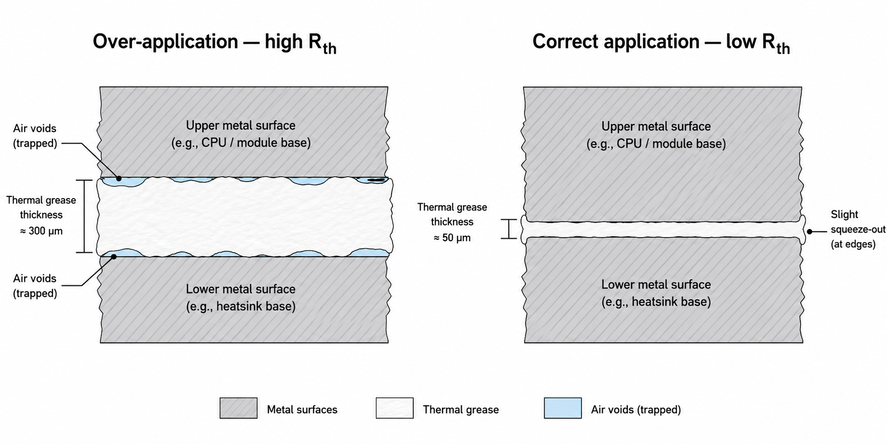
Figure 1. Bondline thickness is the primary process variable for thermal grease performance. A 300 µm bondline produces 6× higher interface resistance than a 50 µm bondline using the same material. Consistent clamping force and surface preparation control the final bondline.
Thermal conductivity in filled potting compounds depends on filler loading and filler dispersion. A nominal 1.5 W/m·K specification assumes the filler is uniformly dispersed at the time of cure. Filler settling in storage, incomplete re-dispersion before mixing, or air entrainment during dispensing can reduce effective thermal conductivity below the specification value. Process control - particularly pre-mix agitation and degas - affects the thermal performance of the cured part, not just its mechanical properties.
Thermal pad and paste comparison for reference: thermal paste at 6 W/m·K and 50 µm bondline over 5 cm² produces Rth ≈ 0.017 °C/W. A thermal pad at 3 W/m·K and 0.5 mm bondline over the same area produces Rth ≈ 0.33 °C/W. These values are low relative to encapsulant resistance, confirming that in potted assemblies, the interface material contributes minimally to total thermal resistance compared to the encapsulant layer.
Material Selection Decision Framework
The selection decision reduces to two questions: (1) Is the assembly serviceable or fully encapsulated? (2) Is component temperature a design constraint?
- Serviceable assembly, component temperature is a constraint → specify thermal paste or high-conductivity pad at the interface. Run thermal model with measured heatsink and ambient values. Validate at maximum rated power.
- Fully encapsulated assembly, component temperature is a constraint → specify thermally conductive potting compound. The encapsulant k-value must be included in the thermal model. Interface material selection at the component level is secondary - encapsulant is the dominant resistance. If the potting compound k-value is not known or not measured, the thermal model is incomplete.
- Fully encapsulated assembly, component temperature is not a constraint (e.g., low-power logic at <1 W total dissipation) → standard unfilled epoxy may be acceptable. The decision should be verified by calculating encapsulant Rth and confirming junction temperature remains below rated limit at maximum ambient. Do not assume acceptability without calculation.
For assemblies requiring UL 94 V-0 flame classification, the potting compound must meet the classification requirement. Thermally conductive fillers affect UL ratings. Verify that the compound specification includes UL 94 V-0 certification - not all thermally filled compounds carry this rating.
Further Reading
For assemblies where thermal management and UL 94 V-0 compliance are both required, the appropriate product depends on whether the assembly is serviceable (interface material) or fully encapsulated (potting compound). Both product paths are listed below.
Serviceable heatsink interface - thermal grease. STG-716 provides 2.2 W/m·K thermal conductivity and UL 94 V-0 classification under UL File E470964, in a non-curing silicone paste format with an operating range of −50°C to +180°C. Appropriate where the component must remain accessible for service and where the assembly is not encapsulated.
→ Product Page: STG-716 Flame-Retardant Heatsink Compound - UL 94 V-0, 2.2 W/m·K Thermal Grease
Fully encapsulated assembly - thermal potting compound. E533/H533 provides 1.5 W/m·K thermal conductivity with UL 94 V-0 rating in a two-component epoxy formulation designed for consistent filler dispersion. Appropriate where the encapsulant is the dominant thermal path and where mechanical protection must be provided alongside thermal management.
→ Product Page: E533/H533 Thermally Conductive Epoxy Potting Compound - UL 94 V-0 Rated, 1.5 W/m·K


