


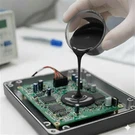


Let's start by understanding what impact resistance really means. Impact resistance refers to a material's ability to withstand sudden force or shock without breaking, cracking, or losing its structural integrity. When it comes to Non Sag Epoxy Encapsulation Glue [/epoxy-resin/epoxy-potting-compound/non-sag-epoxy-encapsulation-glue.html], this is a crucial property, especially in industries where the glued components might be exposed to rough handling, vibrations, or accidental impacts.
How the Glue Builds Impact Resistance
One of the key factors contributing to the impact resistance of our Non Sag Epoxy Encapsulation Glue is its unique formulation. The glue is made up of high - quality epoxy resins and carefully selected hardeners. These components react to form a three - dimensional cross - linked network. This network structure is incredibly strong and flexible at the same time. When an impact occurs, the network can absorb and distribute the energy from the force rather than just letting it concentrate in one spot, which would likely lead to failure.
Another aspect is the non - sag property itself. Since it doesn't sag, it can be applied in various thicknesses and shapes, even in vertical or overhead applications. This allows for a more uniform encapsulation of the components. When a component is evenly encapsulated, the stress from an impact is spread out over a larger area. If the glue were to sag, it could create thin spots or uneven layers, which would make the component more vulnerable to damage when hit.
Real - World Applications and Impact Resistance
In the electronics industry, our Non Sag Epoxy Encapsulation Glue is a game - changer. EElectronic components are often delicate and need protection from physical damage. In electronic assembly applications, electrically conductive epoxy adhesive is also used where both bonding strength and electrical conductivity are required for circuit connections. For example, circuit boards in automotive electronics are constantly exposed to vibrations from the engine and the road. Our glue can encapsulate these boards, providing a protective layer that can withstand the constant jolts. When the car hits a pothole or goes over a bumpy road, the glue absorbs the energy from the impact, preventing the delicate circuits from cracking or getting disconnected.
In the aerospace industry, where components are exposed to extreme conditions, impact resistance is non - negotiable. Our glue can be used to encapsulate sensors and other sensitive equipment on an aircraft. During takeoff, landing, and in flight, these components may experience sudden shocks. The high impact resistance of our Non Sag Epoxy Encapsulation Glue ensures that the equipment remains functional and reliable.
Comparing with Other Glues
Now, let's take a quick look at how our Non Sag Epoxy Encapsulation Glue stacks up against other products in the market. There are some glues out there that claim to have good impact resistance, but they often lack the non - sag property. This means that in real - world applications where the glue needs to stay in place during the curing process, they might not perform as well.
For instance, if we compare it with some flexible epoxy potting compounds like E759 / H759 Semi - flexible Epoxy: Structural - Grade Protection with Controlled Stress Relief [/epoxy-resin/epoxy-potting-compound/flexible-epoxy-potting-low-stress-e759-h759.html], while that product has its own strengths in terms of stress relief, our Non Sag Epoxy Encapsulation Glue might be a better choice when it comes to applications where impact resistance combined with non - sagability is required.
The Thermal Transfer Electronic Potting Epoxy Adhesive [/epoxy-resin/epoxy-potting-compound/thermal-transfer-electronic-potting-epoxy.html] is also a great product, especially for applications where heat transfer is important. However, in terms of pure impact protection, our non - sag glue has a distinct edge because of its robust formulation that focuses on distributing impact energy.
Improving Impact Resistance in Different Conditions
We've also done a lot of research on how to improve the impact resistance of our Non Sag Epoxy Encapsulation Glue in different environmental conditions. Temperature can have a significant effect on the properties of the glue. In colder temperatures, some glues can become brittle and lose their impact resistance. But our glue has been formulated to remain flexible even in low - temperature environments. This is achieved through the addition of special additives that modify the physical properties of the cured glue.
Humidity is another factor. In high - humidity areas, some glues can absorb moisture, which can weaken their structure. Our Non Sag Epoxy Encapsulation Glue has a low moisture absorption rate, ensuring that its impact resistance remains intact even in humid conditions. This is crucial for outdoor applications or in industries like marine, where components are constantly exposed to high humidity and saltwater.
Quality Control and Assurance
As a supplier, we take quality control very seriously. Every batch of our Non Sag Epoxy Encapsulation Glue goes through a series of rigorous tests to ensure its impact resistance meets our high standards. We use advanced testing equipment to simulate real - world impact scenarios, such as drop tests and vibration tests. Only when the glue passes these tests is it released for sale.
We also regularly collect feedback from our customers. If there are any issues or if they have suggestions on how to improve the impact resistance, we take their input very seriously. We have a dedicated R & D team that is constantly working on improving the product based on this feedback and the latest technological advancements.
References
- Industry reports on epoxy encapsulation glues
- In - house research and development data
- Customer feedback and case studies