


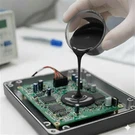


UV adhesive for electronic bonding is widely used for glass bonding, optical assembly, and electronic encapsulation due to its fast curing speed and high transparency. However, when these materials are used in vacuum environments, engineers must consider factors such as outgassing, material stability, and long-term reliability. Understanding these factors helps determine whether UV adhesive is suitable for vacuum electronic applications.
Understanding UV Curable Glue for Glass
First, let's briefly understand what UV curable glue for glass is. UV curable glue is a type of adhesive that cures or hardens when exposed to ultraviolet (UV) light. It offers several advantages, such as rapid curing times, high bond strength, and excellent optical clarity, making it an ideal choice for bonding glass components. The glue typically consists of monomers, oligomers, photoinitiators, and other additives. When UV light hits the photoinitiators, they break down and initiate a chemical reaction that causes the monomers and oligomers to polymerize, forming a solid bond.
The Nature of a Vacuum Environment
A vacuum environment is characterized by extremely low pressure, often with the absence of air or other gases. In such an environment, several physical and chemical phenomena can occur that may affect the performance of materials. For example, outgassing is a common issue in a vacuum. Outgassing refers to the release of gases or vapors from a material when it is placed in a low - pressure environment. These gases can contaminate the surrounding area, affect the performance of sensitive equipment, and potentially weaken the bond formed by the adhesive.
Factors Affecting the Use of UV Curable Glue for Glass in a Vacuum
Outgassing
As mentioned earlier, outgassing is a major concern. The components of UV curable glue, such as solvents, monomers, and additives, may release gases in a vacuum. If the outgassing rate is too high, it can lead to the formation of bubbles or voids in the glue, which can compromise the bond strength and optical properties of the glass - glue interface. To address this issue, some UV curable glues are formulated to have low outgassing characteristics. These glues are often used in applications where a clean vacuum environment is required, such as in space technology or semiconductor manufacturing.


Curing Process
The curing process of UV curable glue also needs to be considered in a vacuum environment. In normal atmospheric conditions, the presence of oxygen can have an inhibitory effect on the curing process of some UV curable glues. However, in a vacuum, the absence of oxygen can actually enhance the curing process in some cases. On the other hand, the lack of air can also affect the heat dissipation during the curing process. Since UV curing generates heat, proper heat dissipation is crucial to prevent overheating, which can lead to thermal stress and potential damage to the glass or the glue itself.
Bond Strength
The bond strength of UV curable glue for glass in a vacuum can be influenced by several factors. The low - pressure environment may cause changes in the physical properties of the glue and the glass surface. For example, the expansion or contraction of the materials due to the pressure difference can put stress on the bond. Additionally, any outgassing - related issues can weaken the bond over time. Therefore, it is essential to test the bond strength of the glue under vacuum conditions to ensure its reliability.
Compatibility with Different Glass Types
Different types of glass have different surface properties and chemical compositions, which can also affect the performance of UV curable glue in a vacuum. For example, borosilicate glass has different thermal expansion coefficients compared to soda - lime glass. When bonding these glasses with UV curable glue in a vacuum, the difference in thermal expansion can cause stress at the bond interface, potentially leading to bond failure. It is important to select a UV curable glue that is compatible with the specific type of glass being used.
Applications of UV Curable Glue for Glass in Vacuum Environments
Space Applications
In the aerospace industry, UV curable glue for glass is used in various space - related applications. For example, it can be used to bond glass windows or optical components in satellites or space probes. In these applications, the glue must be able to withstand the harsh vacuum environment of space, including extreme temperature variations and radiation. Our Single Part UV Cure Resin is designed to meet the stringent requirements of space applications, with low outgassing and high bond strength.
Semiconductor Manufacturing
Semiconductor manufacturing often involves processes carried out in a vacuum. UV curable glue can be used to bond glass substrates or optical elements in semiconductor devices. The low - outgassing properties of the glue are crucial to prevent contamination of the semiconductor chips. Our UV Light Curing Glue for Bonding PMMA is suitable for such applications, providing a reliable bond in a clean vacuum environment.
Testing and Certification
Before using UV curable glue for glass in a vacuum environment, it is essential to conduct thorough testing. This includes outgassing tests, bond strength tests under vacuum conditions, and compatibility tests with different glass types. Many suppliers, including ourselves, offer testing services to ensure that the glue meets the specific requirements of the application. Additionally, some industries may require specific certifications, such as NASA's ASTM E595 outgassing standard for space applications.
Conclusion
In conclusion, UV curable glue for glass can be used in a vacuum environment, but several factors need to be carefully considered. Outgassing, curing process, bond strength, and compatibility with different glass types are all important aspects that can affect the performance of the glue. By selecting the right UV curable glue, conducting proper testing, and following industry standards, it is possible to achieve reliable bonding in a vacuum environment.
If you are interested in our UV curable glue products for glass applications, especially those suitable for vacuum environments, we invite you to contact us for further discussion and potential procurement. Our team of experts is ready to assist you in finding the most suitable solution for your specific needs.
References
- ASTM International. (20XX). ASTM E595 - Standard Test Method for Total Mass Loss and Collected Volatile Condensable Materials from Outgassing in a Vacuum Environment.
- Handbook of Adhesives. Edited by I. Skeist. Van Nostrand Reinhold, New York, 1990.
- Spacecraft Materials Outgassing Data. NASA Technical Memorandum 106985.